Fish Oil vs Krill Oil
Fish Oil and Krill Oil compared on absorption, gut tolerance, and real cost per dose — the cheapest of each pulled live from the Amazon US catalog.
Updated October 2026
Side by side
| Attribute | Fish oil | Krill oil |
|---|---|---|
| EPA/DHA per dose | High | Lower |
| Omega-3 form | Triglyceride / ethyl ester | Phospholipid |
| Absorption | Good | Slightly better g-for-g |
| Aftertaste | Possible burps | Minimal |
| Active deals tracked | 45 | 17 |
| Cheapest cost per dose | $0.06 (per 1200 mg) | $0.09 (per 1000 mg) |
Krill’s phospholipid-bound omega-3s may absorb marginally better gram-for-gram, but fish oil provides several times more EPA/DHA per dose, so it usually wins on delivered omega-3 per dollar.
Which to avoid / caveats
- Compare cost per elemental / active content, not the compound milligrams printed on the label — a bigger number on the front can hide less of what you actually absorb.
- The cheapest sticker price isn’t always the best value: our “cheapest per dose” figures normalise price across bottle sizes, so a larger count only wins if it truly costs less per serving.
Fish OilWell absorbed
Best for: Hitting an EPA/DHA target at the lowest cost and higher-dose use.
Best Fish Oil by cost per doseKrill OilWell absorbed
Best for: No fishy aftertaste, added astaxanthin, and smaller pills — at a premium.
Best Krill Oil by cost per doseCheapest Fish Oil
NEW

🐟 Fish Oil
Nature's Bounty Fish Oil Omega 3 Supplements - Supports Heart…
Cost per serving
$0.06
Cheap·−89%200 servings · ~200-day supply
Well absorbed
$11.71Price from Amazon.com
Nature's Bounty · Amazon.com 0
See the offer Cheapest Krill Oil
NEW
🦐 Krill Oil
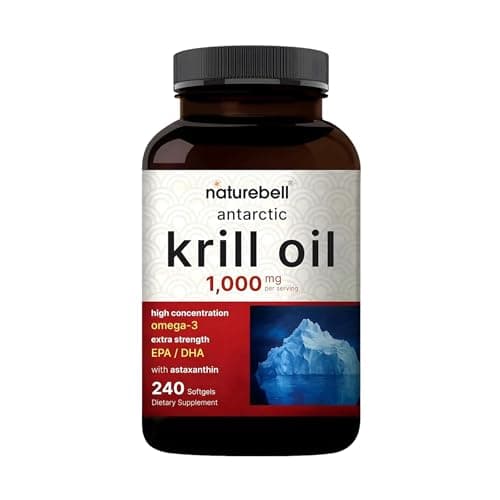
NatureBell Antarctic Krill Oil 1,000mg - 240 Softgels…
Cost per serving
$0.09
Cheap·−82%240 servings · ~240-day supply
Well absorbed
$21.99Price from Amazon.com
NatureBell · Amazon.com 0
See the offer Frequently asked
Is fish oil or krill oil better?+
For most people fish oil wins on value — it delivers several times more EPA/DHA per dollar. Krill oil is better if you want to avoid fishy burps, want the astaxanthin it contains, or prefer smaller pills, and you do not mind paying a premium.
Is krill oil worth the extra cost?+
Only if the perks matter to you — no fishy aftertaste, added astaxanthin, slightly better gram-for-gram absorption. On pure cost per gram of EPA/DHA, fish oil is much cheaper.
Is Fish Oil or Krill Oil cheaper per dose?+
The cheapest Fish Oil we track is $0.06 per serving; the cheapest Krill Oil is $0.09 per serving — so Fish Oil costs less per dose right now (October 2026).
Is there a downside to taking krill oil?+
The main downside for most shoppers is cost: krill oil usually costs more per gram of EPA and DHA than fish oil, partly because per-capsule omega-3 concentrations tend to be lower, so you may need more capsules to reach the same dose. Reported side effects are generally mild and similar to fish oil, such as a fishy aftertaste, burping, or mild stomach upset. Krill are crustaceans, so people with shellfish allergies are often advised to avoid krill oil. If your goal is mainly to reach an omega-3 target for the least money, it helps to compare the actual price per gram of EPA+DHA rather than the price per bottle. This is general information, not medical advice.
Can you take fish oil and krill oil together?+
They deliver the same core omega-3s (EPA and DHA), so taking both mainly means you're paying for two products to get the same nutrients, which usually isn't necessary to hit a dose target. High total doses of omega-3s may affect blood clotting, so if you take blood thinners or have a bleeding disorder it's worth checking with a clinician before combining or taking large amounts. For most shoppers, choosing the single form with the lowest cost per gram of EPA+DHA is a simpler and cheaper way to reach a target than stacking both. This is general information, not medical advice.
Fish oil vs krill oil vs cod liver oil?+
All three supply EPA and DHA but differ in extras and price. Krill oil contains the antioxidant astaxanthin and delivers its omega-3s in phospholipid form, typically at a higher price per gram. Cod liver oil also provides vitamins A and D, which can be a plus unless you already get enough of those, since high intakes of preformed vitamin A can be a concern. Plain fish oil is often the most concentrated and the cheapest per gram of omega-3s. For most people the deciding factors are which added nutrients you want and the price per gram of EPA+DHA. This is general information, not medical advice.
Krill oil vs fish oil for joint pain?+
Some studies suggest omega-3s from either source may modestly ease joint stiffness or discomfort, but the evidence is limited and doesn't clearly show one form is better than the other for joints. Because any benefit depends on getting enough EPA and DHA, the cheaper-per-gram option (often fish oil) lets you reach a meaningful dose for less. Joint pain has many causes, so it's best to treat a supplement as a possible add-on rather than a replacement for proper care, and to discuss persistent joint pain with a clinician. This is general information, not medical advice.
How much Omega-3 do you need per day?+
There is no RDA; the IOM set Adequate Intakes (AIs) for ALA based on omega-3 intakes in healthy populations. For adults 19-50, that is 1.6 g/day for men and 1.1 g/day for women. Pregnancy is 1.4 g/day and lactation 1.3 g/day. The IOM did not establish specific intake recommendations for EPA or DHA. — per the NIH Office of Dietary Supplements; general information, not medical advice.
Can you take too much Omega-3?+
The IOM set no upper limit (UL). High doses (900 mg/day EPA plus 600 mg/day DHA or more for several weeks) might reduce immune function; 2-15 g/day EPA and/or DHA might increase bleeding time. Both the FDA and EFSA consider up to about 5 g/day EPA and DHA safe; in two trials, 4 g/day for several years slightly raised atrial fibrillation risk in people with or at high risk of CVD. Mild side effects include bad breath, heartburn, nausea, and diarrhea. — per the NIH Office of Dietary Supplements; general information, not medical advice.
Dosage & safety answers sourced from the NIH Office of Dietary Supplements. General information, not medical advice.
What the research says
The fact sheet notes that when the IOM last reviewed omega-3s it established Adequate Intakes rather than a Tolerable Upper Intake Level (UL), so no UL is stated. The FDA specifies that the labels of dietary supplements should not recommend a daily intake of EPA and DHA higher than 2 g — per the NIH Office of Dietary Supplements.
A deficiency of essential fatty acids — either omega-3s or omega-6s — can cause rough, scaly skin and dermatitis, and plasma and tissue concentrations of DHA decrease when an omega-3 deficiency is present. However, classical essential fatty acid deficiency in healthy individuals in the United States is virtually nonexistent; clinical signs are usually only found in patients receiving parenteral nutrition that lacks polyunsaturated fatty acids — per the NIH Office of Dietary Supplements.
Related
Best Fish Oil by cost per doseBest Krill Oil by cost per doseFish Oil dosage & factsKrill Oil dosage & factsSupplement price-spread study
People also compare
References & sources
- Health Professional fact sheet — NIH Office of Dietary Supplements
- USP Verified product participants — U.S. Pharmacopeia
- NSF certified products — NSF
We link primary sources and paraphrase their findings — never copy their text, tables, or images. Cost-per-dose figures are our own first-party catalog data.