BCAA vs EAA (Essential Amino Acids)
BCAA and EAA (Essential Amino Acids) compared on absorption, gut tolerance, and real cost per dose — the cheapest of each pulled live from the Amazon US catalog.
Updated September 2026
Side by side
| Attribute | BCAA | EAA |
|---|---|---|
| Amino acids | 3 (leucine, isoleucine, valine) | All 9 essential |
| Can build muscle alone | No — 6 are missing | Yes, with training |
| Typical dose | 5–10 g | 6–15 g |
| Needed if you eat enough protein | Rarely | Rarely |
| Active deals tracked | 28 | 12 |
| Cheapest cost per dose | $0.03 (per 1 g) | $0.05 (per 500 mg) |
Both are free-form amino acids, absorbed quickly without digestion. The difference is completeness: EAAs contain all nine essential amino acids, BCAAs only leucine, isoleucine and valine.
Which to avoid / caveats
- Compare cost per elemental / active content, not the compound milligrams printed on the label — a bigger number on the front can hide less of what you actually absorb.
- The cheapest sticker price isn’t always the best value: our “cheapest per dose” figures normalise price across bottle sizes, so a larger count only wins if it truly costs less per serving.
BCAA
Best for: An intra-workout drink if you already hit your protein target.
Best BCAA by cost per doseEAA (Essential Amino Acids)
Best for: A complete amino-acid top-up when protein intake is low.
Best EAA (Essential Amino Acids) by cost per doseCheapest BCAA
NEW
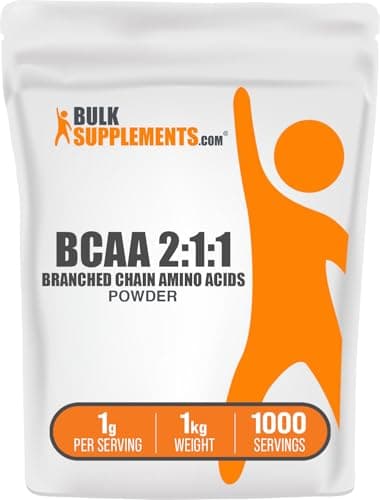
💪 BCAA 3rd-party
BulkSupplements.com BCAA 2:1:1 Powder - Branched Chain Amino…
Cost per serving
$0.03
Cheap·−90%1000 servings · ~1000-day supply
$34.97Price from Amazon.com
BulkSupplements.com · Amazon.com 0
See the offer Cheapest EAA (Essential Amino Acids)
NEW

🧬 EAA (Essential Amino Acids)
Vitamatic L-Lysine 500 mg
Cost per serving
$0.05
Cheap·−89%360 servings · ~360-day supply
$17.99Price from Amazon.com
Vitamatic · Amazon.com 0
See the offer Frequently asked
Are EAAs better than BCAAs?+
For muscle, yes. Muscle protein synthesis needs all nine essential amino acids; BCAAs provide three. Studies of BCAAs alone show little extra muscle gain when daily protein is already adequate. Not medical advice.
Do I need BCAAs or EAAs if I take whey protein?+
Usually not. Whey already contains all nine essential amino acids, including plenty of leucine, and it usually costs less per gram of amino acids than either supplement. Not medical advice.
Is BCAA or EAA (Essential Amino Acids) cheaper per dose?+
The cheapest BCAA we track is $0.03 per serving; the cheapest EAA (Essential Amino Acids) is $0.05 per serving — so BCAA costs less per dose right now (September 2026).
What the research says
Per NIH ODS, up to 20 g/day of BCAA supplements in divided doses appears to be safe, and the fact sheet lists no known adverse effects. For leucine alone, ODS reports that studies suggest an upper safe limit of intake of 500 mg/kg per day in healthy young and elderly men — about 38 g/day for a man weighing 75 kg (165 lb). — per NIH Office of Dietary Supplements; not medical advice.
The BCAAs — leucine, isoleucine, and valine — make up approximately 25% of the amino acids in foods containing complete proteins (those with all essential amino acids), per the NIH Office of Dietary Supplements; most of those foods are animal products such as meat, poultry, fish, eggs, and milk. ODS adds that consuming protein powders made from complete proteins, "especially whey, which has more leucine than either casein or soy," automatically increases BCAA consumption. ODS does not give per-food BCAA gram amounts in this fact sheet.
Related
Best BCAA by cost per doseBest EAA (Essential Amino Acids) by cost per doseBCAA dosage & factsEAA (Essential Amino Acids) dosage & factsSupplement price-spread study
People also compare
References & sources
- Health Professional fact sheet — NIH Office of Dietary Supplements
- USP Verified product participants — U.S. Pharmacopeia
- NSF certified products — NSF
We link primary sources and paraphrase their findings — never copy their text, tables, or images. Cost-per-dose figures are our own first-party catalog data.