Vitamin D3 vs Vitamin D2
Vitamin D3 and Vitamin D2 compared on absorption, gut tolerance, and real cost per dose — the cheapest of each pulled live from the Amazon US catalog.
Updated October 2026
Side by side
| Attribute | D3 | D2 |
|---|---|---|
| Absorption | Well absorbed | Well absorbed |
| Raises 25(OH)D | More, lasts longer | Less, shorter |
| Typical source | Lanolin (or lichen, vegan) | UV-irradiated yeast (vegan) |
| Common use | Daily OTC | Prescription high-dose |
| Active deals tracked | 366 | 18 |
| Cheapest cost per dose | $0.02 (per 5000 IU) | $0.02 (per 400 IU) |
Both forms are well absorbed in the small intestine, and dietary fat helps but is not required. The practical difference is potency: per the NIH, D3 typically increases serum 25(OH)D to a greater extent and sustains it longer than D2.
Which to avoid / caveats
- Vitamin D2 is often the cheaper option, but it’s the lower-absorption form here — Absorbed fine, but less effective than D3 at raising your blood vitamin D for the same dose.
- Compare cost per elemental / active content, not the compound milligrams printed on the label — a bigger number on the front can hide less of what you actually absorb.
- The cheapest sticker price isn’t always the best value: our “cheapest per dose” figures normalise price across bottle sizes, so a larger count only wins if it truly costs less per serving.
Vitamin D3High absorption
Best for: Everyday supplementation and correcting low levels — the form in most OTC products.
Best Vitamin D3 by cost per doseVitamin D2Moderate absorption
Best for: Vegan-by-default (yeast-derived) sourcing and high-dose prescription regimens.
Best Vitamin D2 by cost per doseCheapest Vitamin D3
NEW

☀️ Vitamin D3
Micro Ingredients Vitamin D3 5,000 IU
Cost per serving
$0.02
Cheap·−91%500 servings · ~500-day supply
High absorption
$9.99Price from Amazon.com
Micro Ingredients · Amazon.com 0
See the offer Cheapest Vitamin D2
NEW
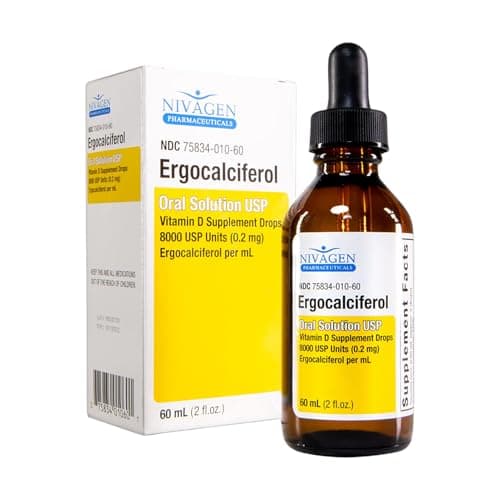
☀️ Vitamin D2
Nivagen Vitamin D2 Liquid Drops 8,000 USP (Ergocalciferol)…
Cost per serving
$0.02
Cheap·−95%1200 servings · ~1200-day supply
Moderate absorption
$21.02Price from Amazon.com
Nivagen · Amazon.com 0
See the offer Frequently asked
What is vitamin D2?+
Vitamin D2 (ergocalciferol) is the plant-derived form of vitamin D, made by exposing yeast or fungi to ultraviolet light. Your body converts it — like D3 — into the active hormone that regulates calcium and bone. Per the NIH Office of Dietary Supplements, D2 is the form used in many high-dose prescription products and some vegan supplements. This is general information, not medical advice.
What is vitamin D3?+
Vitamin D3 (cholecalciferol) is the form your skin makes from sunlight and the form found in animal foods like oily fish; supplements are usually sourced from sheep-wool lanolin (a lichen-derived vegan D3 also exists). Per the NIH, D3 typically raises and sustains blood 25(OH)D more effectively than D2, which is why most supplements use it. This is general information, not medical advice.
Is vitamin D3 better than D2?+
For most people, yes. Both raise vitamin D levels and both treat rickets, but the NIH notes most evidence shows D3 increases serum 25(OH)D more and maintains it longer than D2. This is general information from the NIH Office of Dietary Supplements, not medical advice.
Is vitamin D2 or D3 vegan?+
D2 is made by UV-irradiating yeast, so it is plant-based. Standard D3 is usually derived from sheep-wool lanolin, but a vegan D3 sourced from lichen is also available — check the label if a plant-based source matters to you.
Is Vitamin D3 or Vitamin D2 cheaper per dose?+
The cheapest Vitamin D3 we track is $0.02 per serving; the cheapest Vitamin D2 is $0.02 per serving — so Vitamin D2 costs less per dose right now (October 2026).
How much Vitamin D do you need per day?+
RDAs are 15 mcg (600 IU) for ages 1-70, including pregnancy and lactation, and 20 mcg (800 IU) for those over 70. Infants 0-12 months have an Adequate Intake of 10 mcg (400 IU). These assume minimal sun exposure. — per the NIH Office of Dietary Supplements; general information, not medical advice.
Can you take too much Vitamin D?+
Yes. The Tolerable Upper Intake Level ranges from 25 to 100 mcg (1,000-4,000 IU) by age; adults 19+ are 100 mcg (4,000 IU). Toxicity, almost always from supplements, causes hypercalcemia, hypercalciuria, and high serum 25(OH)D, leading to nausea, kidney stones, and in extreme cases renal failure, soft-tissue calcification, cardiac arrhythmias, and death. — per the NIH Office of Dietary Supplements; general information, not medical advice.
Dosage & safety answers sourced from the NIH Office of Dietary Supplements. General information, not medical advice.
What the research says
Groups more likely to have inadequate vitamin D status include breastfed infants, older adults, people with limited sun exposure, people with dark skin, people with conditions that limit fat absorption, and people with obesity or who have had gastric bypass surgery; deficiency is also more common in people with milk allergy or lactose intolerance or who follow an ovo-vegetarian or vegan diet. In children, deficiency manifests as rickets (soft bones and skeletal deformities), and in adolescents and adults it can lead to osteomalacia (weak, incompletely mineralized bone) — per the NIH Office of Dietary Supplements.
Few foods naturally contain vitamin D: the flesh of fatty fish (such as trout, salmon, tuna, and mackerel) and fish liver oils are among the best sources, while beef liver, egg yolks, and cheese have small amounts, and mushrooms provide variable amounts of vitamin D2. In American diets, fortified foods (for example, milk, ready-to-eat breakfast cereals, and some orange juice, yogurt, and margarine) provide most of the vitamin D — per the NIH Office of Dietary Supplements.
Related
Best Vitamin D3 by cost per doseBest Vitamin D2 by cost per doseVitamin D3 dosage & factsVitamin D2 dosage & factsSupplement price-spread study
People also compare
References & sources
- Health Professional fact sheet — NIH Office of Dietary Supplements
- USP Verified product participants — U.S. Pharmacopeia
- NSF certified products — NSF
We link primary sources and paraphrase their findings — never copy their text, tables, or images. Cost-per-dose figures are our own first-party catalog data.