NMN: dose, the honest evidence, and cost per day
Quick answer
NMN is commonly taken at 250-500 mg per day and reliably raises NAD+ blood markers, but hard anti-aging outcomes in humans are not established — so it's expensive enough that cost per day should drive the buying decision.
Alex Soto, Founder, VitaminDB
6 min readUpdated 7/31/2026 NIH-sourced
On this page
Here is the honest summary: NMN is taken at 250-500 mg a day, it **reliably raises NAD+ markers in the blood, but the human anti-aging outcomes people buy it for are not established. It is also expensive**, which makes cost per day the decision that matters most. This page is a value guide, not medical advice.
What NMN is
NMN (nicotinamide mononucleotide) is a NAD+ precursor — a molecule your body uses to make NAD+, a coenzyme involved in energy metabolism and many cellular processes. NAD+ levels tend to decline with age, and that observation is the entire basis of the longevity and "energy" marketing around NMN. It is sold as a powder or in capsules, usually as a premium-priced product.
The dose
The amounts people use are consistent:
- Commonly 250-500 mg per day.
- That range is what most human studies have used when measuring NAD+ markers.
These are the figures to compare prices against, not a personalized dose.
The honest evidence — read this part
This is where NMN needs plain language, because the marketing runs far ahead of the data:
- What is real: In human studies, NMN does raise NAD+ markers in the blood.
The mechanism works — the precursor gets converted and the marker goes up.
- What is not established: Raising a marker is not the same as living longer,
aging slower, or being measurably healthier. Those **hard clinical outcomes are not proven in people.**
- Where the dramatic claims come from: The eye-catching results — big effects on
aging, metabolism, and lifespan — are largely from animal studies. Animal findings are a reason to investigate, not evidence that the same happens in humans.
So the honest position is that NMN is a **plausible, well-marketed bet with a real mechanism and unproven real-world payoff.** Anyone selling it as confirmed anti-aging is overstating what the evidence supports.
The most direct pooled evidence is negative: a systematic review and meta-analysis of 8 randomised trials in mainly healthy adults did not find that short-term NMN supplementation improved markers of glucose control or lipid profile, and its authors state their findings do not support NMN use in the general population for glucose and lipid metabolism.
A note on regulatory status
Worth knowing before you buy: the **US regulatory status of NMN has been contested**, which has at times affected how and whether it is sold as a dietary supplement. This does not tell you anything about whether it works, but it does mean availability and labeling can shift, so it is reasonable to expect some churn in what is on the market.
NMN vs NR
The most common comparison is NMN against NR (nicotinamide riboside):
- Both are NAD+ precursors — different molecules that the body routes toward
making NAD+.
- Both have been shown to raise NAD+ markers in humans.
- There is no strong human evidence that one is clearly better than the other for
actual outcomes.
Given that, for most buyers the tiebreaker is not biochemistry — it is **cost per day**. If two precursors both raise the same marker and neither has proven a real-world edge, the cheaper effective dose is the rational choice.
Why cost per day is the decision
NMN is one of the more expensive supplements per day, and that changes how you should shop. When a benefit is uncertain, overpaying makes the whole proposition worse, so the price you pay per daily dose is doing real work.
To compare fairly:
- Convert everything to cost per day at your chosen dose (say 250 mg or 500 mg).
- Watch serving sizes — a bottle "500 mg per serving" at two capsules is not the
same value as 500 mg in one.
- Compare NMN against NR on the same cost-per-day basis before deciding which
precursor to buy at all.
The honest bottom line
- Typical dose is 250-500 mg/day.
- NMN raises NAD+ markers, but anti-aging outcomes in people are not proven —
treat it as speculative.
- NMN vs NR is roughly a wash on evidence, so cost per day should decide it.
- If you buy, buy on cost per day so an uncertain bet does not also become an
expensive one.
Check current prices on the NMN nutrient page, see the best-value NMN ranked by cost per dose, and read how we compute cost per serving in our methodology. This is general information, not medical advice.
Covered nutrients: NMN
See the live cost-per-dose data
This guide is editorial — the prices below are real and current.
Frequently asked questions
How much NMN do people take?
Common doses are about 250 to 500 mg per day. That is the range most often used and studied for raising NAD+ markers, not a personalized recommendation. This is general information, not medical advice.
Does NMN actually work for anti-aging?
It reliably raises NAD+ markers in the blood in human studies, which is the mechanism people are excited about. But raising a marker is not the same as living longer or being healthier — hard clinical anti-aging outcomes in people are not established, and the most dramatic results come from animal studies. Treat NMN as an unproven bet, not a proven longevity tool. This is general information, not medical advice.
NMN vs NR — what's the difference?
Both NMN (nicotinamide mononucleotide) and NR (nicotinamide riboside) are NAD+ precursors, meaning the body uses them to make NAD+, and both have been shown to raise NAD+ markers. There is no strong human evidence that one is clearly superior for real-world outcomes, so for most buyers the deciding factor is cost per day. This is general information, not medical advice.
Is NMN worth the cost?
That depends on how you weigh an unproven benefit against a real price. Because the anti-aging outcomes are not established in people and NMN is one of the more expensive supplements per day, the honest position is that it is a speculative purchase — if you buy it, buy on cost per day so you are not overpaying for an uncertain bet.
Where these numbers come from
Cost figures on this page are computed from 43 active NMN listings we track, last re-priced . Cost per dose is price ÷ (servings × dose), computed per listing — not a price we are quoted. Listings under $1 or with fewer than 3 servings are excluded, because both are usually a parse error rather than a bargain.
- Amazon.com · 43
Prices move. Figures written into the text are re-checked against live data on a schedule; the ranking pages are always the current number.
Sources
Health claims on this page are drawn from these sources. Prices and cost-per-dose figures come from our own tracked listings, not from the sources below.
- 1.Effects of Nicotinamide Mononucleotide on Glucose and Lipid Metabolism in Adults: A Systematic Review and Meta-analysis of Randomised Controlled Trials — PubMed Central, NIH National Library of Medicine
- 2.Nicotinamide Mononucleotide (CID 14180) — PubChem, NIH National Library of Medicine
Deals on these nutrients
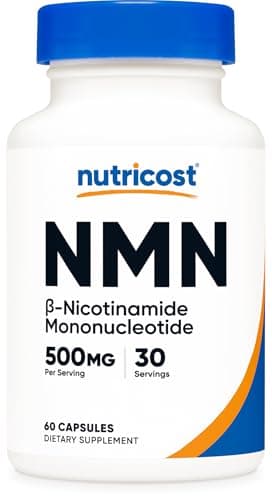
Nutricost NMN (Nicotinamide Mononucleotide) 500mg
Cost per serving
$0.66
30 servings · ~30-day supply

Renue By Science NMN Supplement | 200 SLC Enteric Capsules…
Cost per serving
$0.29
200 servings · ~200-day supply

partiQlar NMN Supplement 500mg - High Purity Nicotinamide…
Cost per serving
$0.73
60 servings · ~60-day supply

CFILIHTC NMN Supplement 500mg - NMN NAD Supplement…
Cost per serving
$0.04
240 servings · ~240-day supply
Related guides
The longevity supplement stack: what it actually costs per day
NMN, resveratrol, and CoQ10 are the popular longevity stack. Honest doses, an honest read on the human evidence, and how to total your real cost per day.
Ubiquinol vs ubiquinone: which CoQ10 is worth it
Ubiquinol absorbs somewhat better, but it costs about 2.5x more per 100 mg than ubiquinone — a median $0.335 vs $0.133 across 55 listings we price. What that gap is worth, the dose, and the statin question.
P-5-P vs regular vitamin B6: is the active form worth it?
P-5-P costs about 2x more per 50 mg than plain pyridoxine — a median $0.146 vs $0.071 across 56 listings we price. Most healthy people convert plain B6 fine, so here is what the premium buys, and the safety ceiling that matters more than either form.
Beetroot vs citrulline: which for pumps, and which for endurance
Both raise nitric oxide, but by different routes and for different goals — beetroot has the endurance edge, citrulline is the gym-pump staple. Doses, the honest split, and cost per dose.