Ubiquinol vs ubiquinone: which CoQ10 is worth it
Quick answer
Ubiquinol absorbs somewhat better, but it runs about 2.5x the price: across the 56 CoQ10 listings we track, the median ubiquinol costs $0.335 per 100 mg against $0.133 for ubiquinone (checked 19 September 2026). At a 200 mg daily dose that is roughly $20 a month versus $8. A well-made oil-based ubiquinone closes most of the absorption gap, so unless ubiquinol is close in price, ubiquinone is the better value. Studied doses run 100-200 mg/day with a fatty meal.
Alex Soto, Founder, VitaminDB
7 min readUpdated 8/26/2026 NIH-sourced
Ubiquinol
"body-ready"
Ubiquinone
best value
Absorption
Cost per 100 mg (median)
Shelf stability
Edge after ~40
Best for
Verdict: Ubiquinol costs about 2.5x more per 100 mg (median $0.335 vs $0.133), and a well-made oil-based ubiquinone closes most of the absorption gap — so ubiquinone is usually the better value. Ubiquinol earns its price after about 40, or whenever the two are close. Studied doses run 100-200 mg/day with a fatty meal.
On this page
CoQ10 is one of the pricier everyday supplements, so the ubiquinol-vs-ubiquinone decision actually moves money. Here's how to make it without overpaying.
What the gap actually costs
Every guide says ubiquinone is "the cheaper form" and stops there. Here is the size of it, from the 56 CoQ10 listings we price (checked 19 September 2026):
- Ubiquinone — median $0.133 per 100 mg across 33 listings; the cheapest works out to $0.015.
- Ubiquinol — median $0.335 per 100 mg across 22 listings; the cheapest is $0.042.
So the median ubiquinol costs 2.5x the median ubiquinone. At the middle of the studied range — 200 mg a day — that is about $0.27 a day (~$8 a month) for ubiquinone against $0.67 a day (~$20 a month) for ubiquinol, or roughly $145 more a year for the premium form.
Two things that gap does not tell you. Ubiquinol's absorption edge is real but modest, and it is nowhere near 5x. And the spread inside each form is wider than the spread between them — the dearest ubiquinol we list costs 39x the cheapest one, so picking the form matters less than not overpaying within it. Live figures on best-value CoQ10.
The two forms
CoQ10 exists in two interconvertible forms:
- Ubiquinone — the oxidized, standard form. Cheaper and very stable. Absorption is modest (like all CoQ10), but a well-made oil-based softgel taken with food works well for most healthy people.
- Ubiquinol — the reduced, "body-ready" form. Tends to absorb somewhat better, which matters more after about age 40, when the body converts CoQ10 less efficiently. It costs more and is less shelf-stable.
The honest summary: ubiquinol is the better pick if you're older or want maximum absorption and budget isn't the constraint; ubiquinone is the value choice for most younger, healthy people. The full head-to-head with live pricing is on CoQ10 ubiquinol vs ubiquinone.
Absorption is the real lever
CoQ10 of any form is fat-soluble and poorly absorbed on an empty stomach. Two things matter more than the ubiquinol-vs-ubiquinone debate for most people:
- Take it with a meal that contains fat.
- Choose an oil-based softgel, not a dry powder capsule — the formulation often matters as much as the form.
A good oil-based ubiquinone with a fatty meal can rival a poorly formulated ubiquinol.
One claim to retire before choosing a form: NCCIH states that the overall scientific evidence does not support the idea that CoQ10 can reduce muscle pain caused by statins, while noting evidence that CoQ10 may reduce the risk of some complications of heart surgery. The statin-muscle claim sells a lot of ubiquinol.
Dose
Studied doses generally run 100–200 mg/day (split if higher). More isn't automatically better, and it's a general reference, not medical advice.
Who actually benefits
CoQ10 is marketed as a general "energy" and "anti-aging" supplement, but the honest picture is narrower. Your body makes its own CoQ10, and for a healthy person eating a normal diet, a supplement has no clearly demonstrated benefit. The evidence clusters around a few specific situations:
- Migraine prevention. This is the strongest everyday case. Several trials support CoQ10 (commonly ~300 mg/day, often split) as a preventive — it won't stop a migraine already underway, and it takes weeks to judge.
- Statin users with muscle symptoms. Covered below — plausible, evidence mixed, low-risk to trial.
- Heart failure, as an adjunct. Studied alongside standard care, not as a replacement for it — a clinician's call.
- Age 40+ chasing absorption. Not a "benefit" so much as a reason to prefer ubiquinol, since conversion slows with age.
If none of these describe you, CoQ10 is an optional supplement, not an essential one — and that's a fine reason to buy the cheapest effective form rather than the premium one.
The statin question
Statins reduce the body's own CoQ10 synthesis, which is why CoQ10 is so often paired with them — particularly for people with statin-associated muscle symptoms. The evidence that it relieves those aches is mixed, but it's low-risk and reasonable to trial with your prescriber's awareness.
How to buy without overpaying
CoQ10 prices vary widely, so it rewards a cost-per-dose comparison: pick your form, insist on an oil-based softgel, target 100–200 mg, then compare what a real daily dose costs. Current picks: best-value CoQ10 and the CoQ10 hub. We rank by cost per effective dose, not sticker price (methodology).
Bottom line
Under ~40 and healthy: a well-formulated oil-based ubiquinone with a fatty meal is the value play. Older, or chasing absorption: ubiquinol. Either way, dose 100–200 mg with food, and let cost-per-dose pick the specific bottle.
Covered nutrients: CoQ10
See the live cost-per-dose data
This guide is editorial — the prices below are real and current.
Frequently asked questions
Ubiquinol or ubiquinone — which should I buy?
Ubiquinol is the reduced, "body-ready" form and tends to absorb somewhat better, which matters more after about 40 when the body converts CoQ10 less efficiently. Ubiquinone (regular CoQ10) is very stable, works well for most younger healthy people as an oil-based softgel taken with a fatty meal, and costs far less — a median $0.133 per 100 mg against $0.335 for ubiquinol across the 55 listings we price (19 September 2026). Full side-by-side at the link below.
Is ubiquinol worth the extra money?
Usually not, unless you are over about 40 or the two are close in price. Ubiquinol runs roughly 2.5x more per 100 mg — a median $0.335 versus $0.133 for ubiquinone (55 listings, 19 September 2026), which at a 200 mg daily dose is about $20 a month against $8, or some $145 a year. Ubiquinol's absorption advantage is real but modest, and it is nowhere near 2.5x. Worth knowing — the price spread within each form is wider than the gap between them, so choosing a well-priced ubiquinone matters more than choosing the form.
How much CoQ10 per day?
Studied doses generally run 100–200 mg/day. Take it with a meal that contains fat, since CoQ10 is fat-soluble. General reference, not medical advice.
Do I need CoQ10 if I take a statin?
Statins can lower the body's CoQ10 levels, which is why supplementation is often discussed for statin users (e.g. for muscle symptoms). Evidence on whether it relieves statin muscle aches is mixed — reasonable to try, worth discussing with your prescriber.
Does CoQ10 actually do anything, or is it hype?
It depends on who's taking it. For most healthy people with a normal diet, a CoQ10 supplement has no clearly demonstrated benefit — the body makes its own. The evidence is strongest in specific situations, chiefly migraine prevention (where several trials support it as a preventive) and as an adjunct in heart failure, plus the statin-muscle discussion. If none of those apply to you, it is an optional supplement, not an essential one.
When should I take CoQ10 — morning or night?
Timing matters less than taking it with fat. CoQ10 is fat-soluble and absorbs poorly on an empty stomach, so take it with your largest meal that contains some fat. Many people take it with breakfast or lunch rather than at night, since a minority find it mildly energizing, but there is no strong rule — consistency and a fatty meal matter more than the clock.
Where these numbers come from
Cost figures on this page are computed from 77 active CoQ10 listings we track, last re-priced . Cost per dose is price ÷ (servings × dose), computed per listing — not a price we are quoted. Listings under $1 or with fewer than 3 servings are excluded, because both are usually a parse error rather than a bargain.
- Amazon.com · 75
- SuperSmart · 2
Prices move. Figures written into the text are re-checked against live data on a schedule; the ranking pages are always the current number.
Sources
Health claims on this page are drawn from these sources. Prices and cost-per-dose figures come from our own tracked listings, not from the sources below.
- 1.Coenzyme Q10 — NIH National Center for Complementary and Integrative Health
Deals on these nutrients
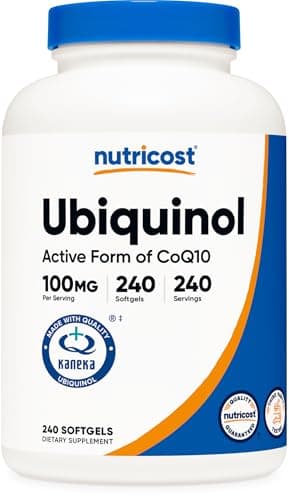
Nutricost Ubiquinol Softgels (100mg
Cost per serving
$0.30
240 servings · ~240-day supply
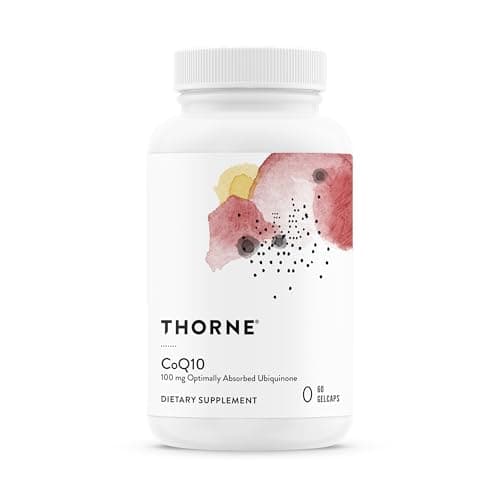
THORNE - CoQ10 - 100mg Optimally Absorbed Ubiquinone…
Cost per serving
$0.88
60 servings · ~60-day supply
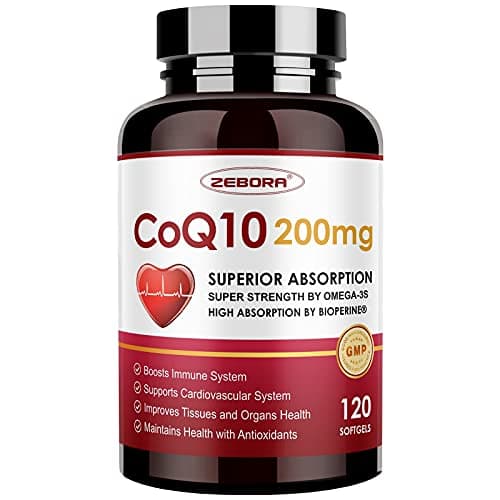
ZEBORA CoQ10-200mg-Softgels with PQQ
Cost per serving
$0.18
120 servings · ~120-day supply

NATURELO Whole Food CoQ10 Supplement
Cost per serving
$0.33
120 servings · ~120-day supply
Related guides
The longevity supplement stack: what it actually costs per day
NMN, resveratrol, and CoQ10 are the popular longevity stack. Honest doses, an honest read on the human evidence, and how to total your real cost per day.
Is the 'premium' supplement form worth the money?
Chelated magnesium, bisglycinate iron, ubiquinol CoQ10, picolinate zinc — the upgraded forms often cost several times more per dose for a real-but-modest benefit that matters for some people and is pure marketing for others. When to pay up and when to skip it.
P-5-P vs regular vitamin B6: is the active form worth it?
P-5-P costs about 2x more per 50 mg than plain pyridoxine — a median $0.146 vs $0.071 across 56 listings we price. Most healthy people convert plain B6 fine, so here is what the premium buys, and the safety ceiling that matters more than either form.
Beetroot vs citrulline: which for pumps, and which for endurance
Both raise nitric oxide, but by different routes and for different goals — beetroot has the endurance edge, citrulline is the gym-pump staple. Doses, the honest split, and cost per dose.