Inulin (prebiotic fiber): dose, gut benefits, and cost per gram
Quick answer
Most people start inulin around 5 g per day and build slowly toward 10 g, so compare products by cost per gram of fiber rather than per tub.
Alex Soto, Founder, VitaminDB
6 min readUpdated 8/1/2026 NIH-sourced
On this page
Most people start inulin at about 5 g per day and build slowly toward 10 g, and because it is an inexpensive powder, the honest way to buy it is by cost per gram of fiber, not per tub. Inulin is a soluble prebiotic fiber that feeds beneficial gut bacteria and supports regularity — with one predictable catch, gas, that you manage by ramping up gradually.
We sell nothing. We rank inulin by cost per gram.
What inulin is
Inulin is a soluble, fermentable fiber, most often extracted from chicory root (it also occurs naturally in foods like onions, garlic, and Jerusalem artichoke). You'll sometimes see FOS (fructooligosaccharides) on labels next to it — that's a related, shorter-chain version of the same family, and the two are often sold together or blended.
What makes inulin a prebiotic is that your small intestine doesn't digest it. It travels to the colon intact, where gut bacteria ferment it. That fermentation is the point: it's thought to feed beneficial bacteria and support regularity. It's also the source of the side effect below.
The dose: start low, build to about 5-10 g/day
A common daily range is about 5-10 g, but the number that matters more is how you get there:
- Start low — often around a teaspoon (a few grams) — and increase slowly over a week or two.
- Ramping up gradually gives your gut bacteria time to adjust, which reduces gas.
- Higher amounts, taken too fast, are the main cause of discomfort.
There's no single "correct" dose for everyone; it depends on your usual diet and how you tolerate it. The right amount for any individual is best judged by starting small and paying attention to how you feel.
Why inulin causes gas and bloating
This is the honest trade-off, and it's worth stating plainly: because inulin is fermented by gut bacteria, that fermentation produces gas. Bloating and flatulence are common, especially:
- at higher doses,
- when you increase quickly, and
- for people with IBS or those following a low-FODMAP plan — inulin is a FODMAP, so it can be a strong trigger.
The fix for most people is simply pacing: start with a small amount and build up. If you have IBS or a diagnosed gut condition, be cautious and consider talking to a clinician before adding a fermentable fiber. None of this is medical advice.
What the prebiotic claim actually rests on: a systematic review of inulin-type fructans found a strong bifidogenic effect on the human faecal microbiota — that is, it reliably feeds bifidobacteria. That is the mechanism doing the work in the marketing; specific health outcomes are a separate, thinner literature.
Inulin vs psyllium
These get lumped together as "fiber," but they behave differently:
- Inulin is fermentable and acts as a prebiotic — it feeds gut bacteria. That's also why it produces gas.
- Psyllium is more of a bulking fiber, studied for stool bulk and for cholesterol. It ferments much less, so it typically causes less gas.
They're not really competitors. If your goal is feeding gut bacteria, inulin fits; if it's bulk or cholesterol support, psyllium is the more-studied choice. Some people use both. You can read our psyllium guide for that side of the comparison.
How to compare inulin by cost per gram
Inulin is one of the cheaper supplements out there, which is exactly why price per tub tells you almost nothing — tubs vary hugely in size and in grams of fiber per scoop. Normalize to grams:
- Find the grams of inulin fiber per serving on the label (watch for blends where only part of the scoop is inulin).
- Work out the total grams of fiber in the container.
- Cost per gram = price ÷ total grams.
That single figure lets you line up a small capsule product against a big powder tub on equal terms, and it often flips which one looks cheaper. Capsules almost always cost far more per gram than plain powder, so if you tolerate powder, it's usually the better value.
Our best inulin by cost per gram page ranks products cheapest-first; browse listings on the inulin nutrient page, and see how we normalize grams and servings in our methodology.
Bottom line
- Inulin is a soluble prebiotic fiber (chicory root; FOS is a related short-chain version) that feeds gut bacteria and supports regularity.
- Dose is about 5-10 g/day — start low and ramp up slowly to limit gas.
- Gas and bloating are common, worse at high doses and for IBS/low-FODMAP; inulin is a FODMAP.
- Psyllium is different: a bulking/cholesterol fiber that ferments less.
- Buy on cost per gram of fiber, not per tub.
Price it per gram, start small, and build up. This is general information, not medical advice.
Covered nutrients: Inulin (prebiotic fiber)
See the live cost-per-dose data
This guide is editorial — the prices below are real and current.
Frequently asked questions
How much inulin should I take per day?
A common range is about 5-10 g per day, and the usual advice is to start low — around a teaspoon — and increase slowly over a week or two so the gut adjusts. Higher amounts raise the chance of gas and bloating. The right amount for any individual depends on their diet and tolerance. Not medical advice.
Does inulin cause gas and bloating?
Yes, this is common, because inulin is fermented by gut bacteria and that process produces gas. It tends to be worse at higher doses and when you ramp up quickly. People with IBS or on a low-FODMAP plan often react more strongly, since inulin is a FODMAP. Starting small and building slowly usually helps. Not medical advice.
Inulin vs psyllium — what's the difference?
They are different kinds of fiber. Inulin is fermentable and acts as a prebiotic — it feeds beneficial gut bacteria. Psyllium is more of a bulking fiber, studied for stool bulk and for cholesterol, and it ferments less, so it usually causes less gas. Some people use one, some combine them. Not medical advice.
How do I compare inulin products on cost?
Inulin is a cheap powder, so price per tub is misleading. Find the grams of inulin fiber per serving, work out how many grams the container holds in total, then divide the price by total grams to get cost per gram. Compare that figure across brands and forms.
Where these numbers come from
Cost figures on this page are computed from 6 active Inulin (prebiotic fiber) listings we track, last re-priced . Cost per dose is price ÷ (servings × dose), computed per listing — not a price we are quoted. Listings under $1 or with fewer than 3 servings are excluded, because both are usually a parse error rather than a bargain.
- Amazon.com · 6
Prices move. Figures written into the text are re-checked against live data on a schedule; the ranking pages are always the current number.
Sources
Health claims on this page are drawn from these sources. Prices and cost-per-dose figures come from our own tracked listings, not from the sources below.
- 1.The Prebiotic Potential of Inulin-Type Fructans: A Systematic Review — PubMed Central, NIH National Library of Medicine
Deals on these nutrients

Psyllium Husk 1500mg Per Serving
Cost per serving
$0.07
300 servings · ~300-day supply

Now Supplements, Prebiotic Inulin Fiber, 180 Veg Capsules
Cost per serving
$0.10
180 servings · ~180-day supply

Wild & Organic Chicory Root Capsules - Digestive & Gut Support…
Cost per serving
$0.31
90 servings · ~90-day supply
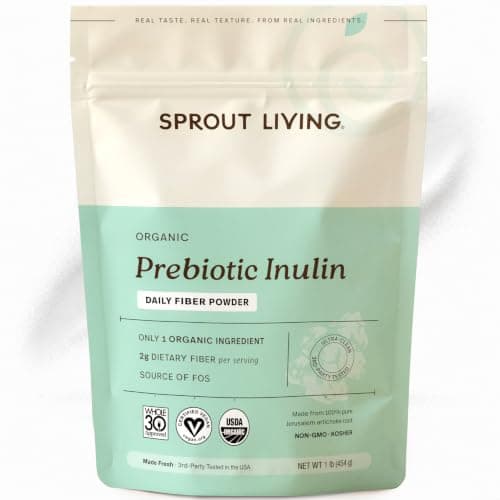
Sprout Living Organic Inulin with FOS Prebiotic Powder
Cost per serving
$0.22
90 servings · ~90-day supply
Related guides
Ubiquinol vs ubiquinone: which CoQ10 is worth it
Ubiquinol absorbs somewhat better, but it costs about 2.5x more per 100 mg than ubiquinone — a median $0.335 vs $0.133 across 55 listings we price. What that gap is worth, the dose, and the statin question.
P-5-P vs regular vitamin B6: is the active form worth it?
P-5-P costs about 2x more per 50 mg than plain pyridoxine — a median $0.146 vs $0.071 across 56 listings we price. Most healthy people convert plain B6 fine, so here is what the premium buys, and the safety ceiling that matters more than either form.
Beetroot vs citrulline: which for pumps, and which for endurance
Both raise nitric oxide, but by different routes and for different goals — beetroot has the endurance edge, citrulline is the gym-pump staple. Doses, the honest split, and cost per dose.
Beta-alanine: dose, the tingling, and what it actually does
Beta-alanine buffers muscle acid to extend high-intensity efforts in the 1–4 minute range. It works by loading over weeks, not as a pre-workout kick. Real dose, why it tingles, and cost per serving.